
Dental Implants
Dental implants are the standard for replacing missing teeth. They are a long-term, natural-looking solution that restores both function and confidence. Unlike dentures or bridges, implants replace the tooth root itself, helping preserve jawbone health.
What Is a Dental Implant?
A dental implant is a titanium post surgically placed into the jaw to replace a missing tooth root. Once it integrates with the surrounding bone, a custom crown is attached, creating a replacement that looks, feels, and functions like a natural tooth.
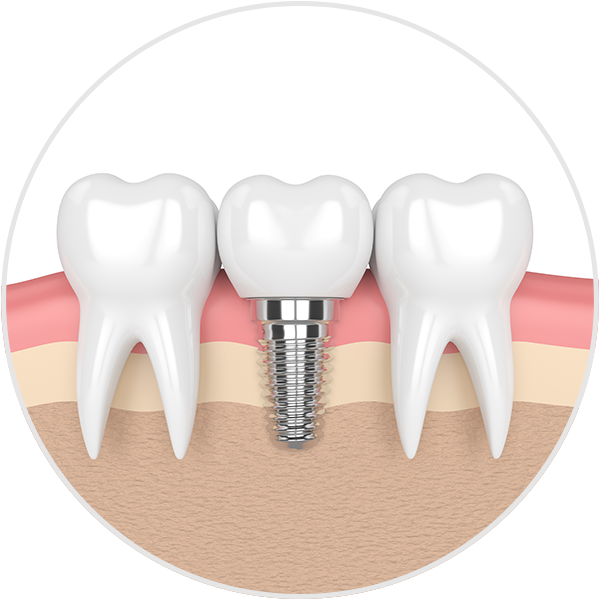
Every implant has three components:
- Implant — the titanium post placed into the jaw (replaces the root of the tooth)
- Abutment — the connector between the implant and the crown
- Crown — the prosthetic tooth placed by your dentist or prosthodontist
Tooth Replacement Options
A missing tooth can affect your bite, speech, and ability to eat. When you rely more on your remaining teeth, you increase the chance they wear out, become damaged, or are lost. You can select from a number of options to replace missing teeth, from temporary to long-lasting solutions. Your dentist and implant surgeon will review these with you so you can make the most informed decision.
A good candidate is anyone missing one or more teeth, or who is unhappy with their dentures. Smoking, diseases such as diabetes, osteoporosis (bone disease), and radiation therapy to the area can lower the success rate of implant placement. X-rays of your jaw are taken to evaluate whether it can accommodate implants.
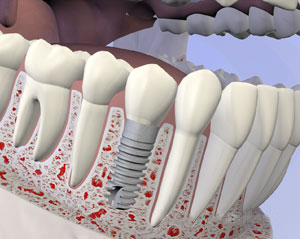
Dental Implants
The most stable and long-term solution. Implants form a strong foundation, keep the jaw healthy, and, unlike bridges, damage no healthy teeth, and have an excellent long term track record.
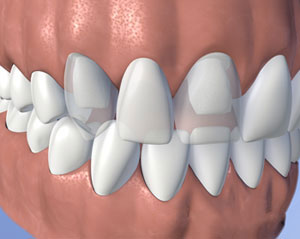
Fixed Bridge
A connected set of replacement teeth, cemented onto the adjacent teeth for support. The outer layer of those teeth is usually ground down first.
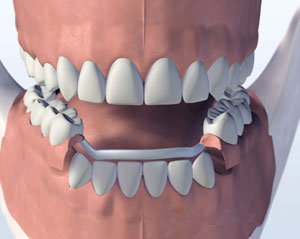
Metal Partial
A sturdier removable partial denture cast in metal and plastic, held in place by wire clips/clasps. It can be removed and reinserted as needed.
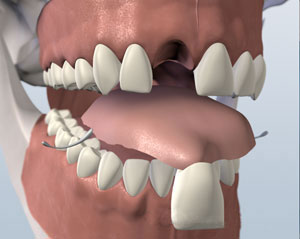
Flipper
A fragile, temporary, and inexpensive solution, a removable plastic tooth held by a plastic retainer.
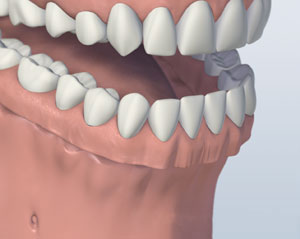
Denture
The most common solution for people missing all teeth in one or both jaws. Some people adapt well; others find dentures uncomfortable due to differences in jaw size, shape, and retention.
Why Choose Dental Implants?
Implants are the only tooth replacement option that also preserves the jawbone. When a tooth root is missing, the surrounding bone begins to shrink and deteriorate, up to 30% in the first year, leading to loss of cleaning efficiency, damage to other teeth, and a sunken facial appearance over time.
This can also create increased difficulty to ultimately replace these teeth with time. Implants prevent this by integrating with the bone.
Compared to dentures and bridges, implants offer:
- A long-term fit — no slipping, pinching, or adhesives
- No damage to adjacent teeth (unlike a traditional bridge)
- Better chewing strength and natural speech
- Long-term cost savings — dentures require replacement every 5–10 years; implants can last a lifetime
- Preservation of facial structure and bone health
- Less dietary restrictions and the ability to socialize comfortably with teeth that look and function naturally
Implant Options
We offer a full range of implant solutions, from a single tooth to a complete arch restoration:
Single Tooth Implant
Replaces one missing tooth without affecting neighboring teeth. The most common implant procedure.
Immediate Implant
The tooth can be extracted and the implant placed in the same visit, reducing overall treatment time.
Removable Implant-Supported Denture
Replaces a full upper or lower set of teeth. Secured by as few as 2–4 implants using ball or bar attachments, making them far more stable than traditional dentures while remaining removable for easier cleaning.
Fixed Implant-Supported Denture (All-on-4 / Hybrid)
A full-arch prosthesis permanently anchored to implants. Can often be placed the same day as extractions in eligible patients.
The Implant Process
Dental implant treatment is a collaboration between our oral surgeons and your dentist or prosthodontist. Drs. Torio, Decoteau, Burk, Madden, or Farr handle the surgical placement, initial extractions, and bone grafting if needed; your dentist designs and fits the final crown or prosthesis. We pride ourselves on seamless communication between our offices throughout your treatment.
When Are Implants Placed & How Many Do I Need?
Implants are often placed several months after extraction, though in some cases an implant can be placed immediately after a tooth is removed. This can expedite the process, but may not be recommended when infection or bone problems are present. If a tooth has been missing for some time, the supporting bone thins and shrinks; as much as one third of the jaw’s thickness can be lost in the first year, which may make bone grafting necessary before placement.
Most frequently, one implant is placed per missing tooth. Because many of the larger teeth in the back of the jaw have two or three roots, missing back teeth are commonly replaced with larger implants.
Replacing All Upper or Lower Teeth
Several implant-supported replacement options are available if you are missing all of your teeth in an arch. While many patients wear an upper denture comfortably, lower dentures can be harder to wear and eat with — implants provide far greater stability.
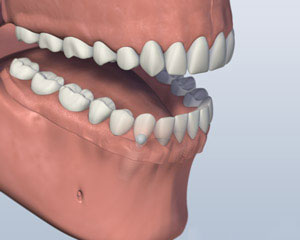
Ball Attachment Denture
Two-four implants are placed in the lower jaw and a denture is made to snap onto them. This makes the lower denture more stable while chewing, though some movement remains and periodic adjustments are needed.
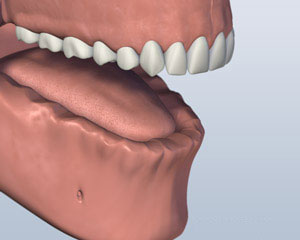
1. Before
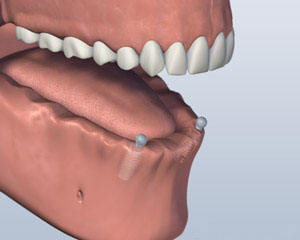
2. Implants Placed
3. Denture Attached
Bar Attachment Denture
Four to six implants are placed in the lower jaw and connected with a custom support bar. The denture has internal retention clips that snap firmly onto the bar (an “overdenture”). This is much more stable than the ball attachment option, with very little movement, and remains removable for easy cleaning.
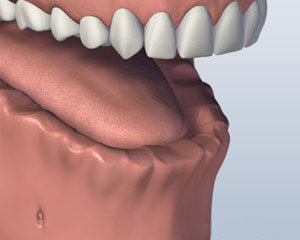
1. Before
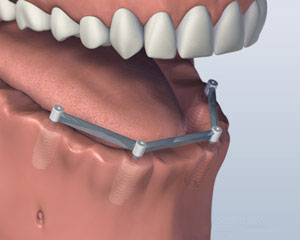
2. Implants Placed
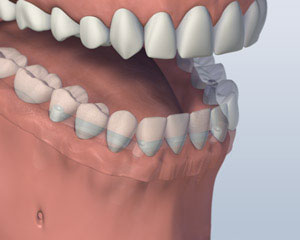
3. Denture Attached
Individual Implants
All teeth are replaced individually so they appear to grow out of the gum tissue, most closely resembling natural teeth. This usually requires eight or more implants with individual abutments and crowns. It is the most costly option, and may be limited by the size and shape of your jawbone.
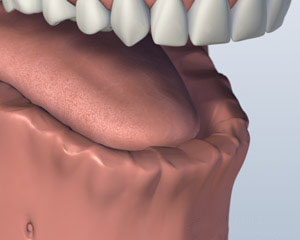
1. Before
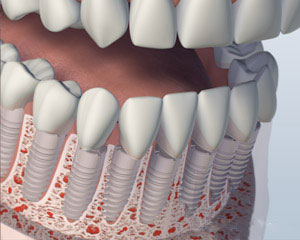
2. Implants Placed
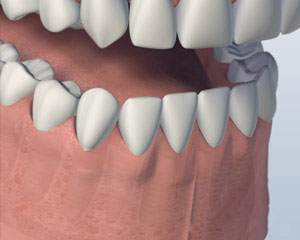
3. Healing Completed
Upper Teeth Options
A similar range of options is available for the upper jaw, though more implants are often needed because the upper bone is softer. An Implant Retained Upper Denture can, depending on the number of implants, eliminate the need to cover the roof of your mouth. This lets you fully taste and feel the temperature of food while keeping the denture removable for cleaning. For a fixed, natural-feeling result, eight to ten individual upper implants can be placed, followed by abutments and crowns.
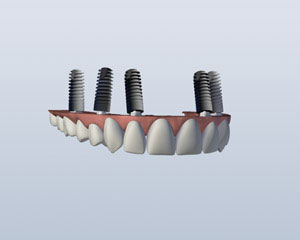
1. Before
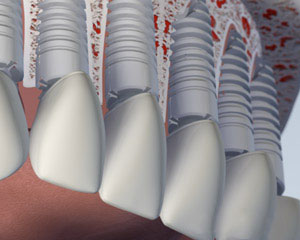
2. Implants Placed
Dental Implants Presentation
To provide you with a better understanding of dental implants, we have provided the following multimedia presentation. Many common questions pertaining to dental implants are discussed.
Am I a Candidate?
Most adults missing one or more teeth are good candidates. During your consultation, our surgeons will evaluate:
- Bone density and volume (bone grafting can address deficiencies)
- Location of sinuses and nerves
- Overall health, including smoking history, diabetes, osteoporosis, or history of radiation/cancer treatment
- Immune status, certain immune disorders or blood conditions may affect candidacy
Even patients who have been told they are “not candidates” elsewhere may have options. Our surgeons are trained to manage complex cases, including medically complex patients requiring specialized anesthesia.
Why Apex Oral Maxillofacial Surgery?
Our oral and maxillofacial surgeons have the advanced surgical training to handle the full spectrum of implant cases, from routine single-tooth placements to complex cases involving significant bone loss or medically involved patients.
- 3D CT imaging and computer-guided implant placement for precision and predictability
- In-house bone grafting expertise for patients with compromised jawbone
- Specialized anesthesia and sedation options for patient comfort
- Seamless coordination with your referring dentist or prosthodontist
- Thousands of successful implant surgeries across all levels of complexity
Ready to get started?
Call 603-883-4008 to schedule your implant consultation at our Nashua or Bedford office. You can also request an appointment online.